evidence and impact
January 15, 2006
Silk and Silver Medallions
I started a piece yesterday which will incorporate a dozen medallions, each roughly 2.5 to 3". The medallions are made with various dark red/maroon felted wool bases, then a layer of silver metallic, a piece of silk salvaged from a tie, and a charm.
The silver metallic pieces are made from a variety of materials. Several are lame type fabrics, a couple are vinyls with a knit backing, and some are pieces of plastic/foil or ?? I'm always on the lookout for metallic materials that can be sewn, and some of my finds are working well with this piece. For instance, a plastic (according to the package) disposable tablecloth that is as bright and shiny as foil. Also the freshness seals from plastic food cans. Plastic coffee and non-dairy coffee creamer containers usually have seals that look something like dull aluminium but feel like plastic. A type of fish food I use comes in a can with a beautiful waffle-textured seal that looks and feels like a thick foil but seems to have a plastic blended into it.
The silk pieces, although not a lot is visible, have an interesting "look" because I retained the bias orientation of the original ties. I did use an iron on stabalizer to reduce distortion.
The charms are made from little pieces (various grits) of used sandpaper covered with ducting tape and then etched with designs using something pointed. The tape is very shiny and is used to seal heating ducts at connections, not the cloth type duck tape. I read instructions for making them about a year ago (I can't remember where) and made a bunch of them last Spring, including the 12 I'm using in this piece. I've been thinking about this piece since then; yesterday I finally got started.
Here are the first 6 medallions:

I scanned them then punched the colors up a bit. It's not an accurate representation but it's as close as I am able to get. The metallic layer on the bottom right medallion didn't scan true at all, it is actually a very shiny fabric. The metallic on the 2 top medallions is cut from the tablecloth, it scanned well enough to show a bit of the embossed design.
My plan is to attach these medallions to a background, I'll start on that as soon as the medallions are done. ¶ 12:15 AM
The silver metallic pieces are made from a variety of materials. Several are lame type fabrics, a couple are vinyls with a knit backing, and some are pieces of plastic/foil or ?? I'm always on the lookout for metallic materials that can be sewn, and some of my finds are working well with this piece. For instance, a plastic (according to the package) disposable tablecloth that is as bright and shiny as foil. Also the freshness seals from plastic food cans. Plastic coffee and non-dairy coffee creamer containers usually have seals that look something like dull aluminium but feel like plastic. A type of fish food I use comes in a can with a beautiful waffle-textured seal that looks and feels like a thick foil but seems to have a plastic blended into it.
The silk pieces, although not a lot is visible, have an interesting "look" because I retained the bias orientation of the original ties. I did use an iron on stabalizer to reduce distortion.
The charms are made from little pieces (various grits) of used sandpaper covered with ducting tape and then etched with designs using something pointed. The tape is very shiny and is used to seal heating ducts at connections, not the cloth type duck tape. I read instructions for making them about a year ago (I can't remember where) and made a bunch of them last Spring, including the 12 I'm using in this piece. I've been thinking about this piece since then; yesterday I finally got started.
Here are the first 6 medallions:
I scanned them then punched the colors up a bit. It's not an accurate representation but it's as close as I am able to get. The metallic layer on the bottom right medallion didn't scan true at all, it is actually a very shiny fabric. The metallic on the 2 top medallions is cut from the tablecloth, it scanned well enough to show a bit of the embossed design.
My plan is to attach these medallions to a background, I'll start on that as soon as the medallions are done. ¶ 12:15 AM
January 12, 2006
Virtual Needlework Sketches
Thank you to everyone who left nice comments.
I have been working on a couple of quilts which should be finished and photographed soon. Hopefully by next week.
My days have been filled with a wide variety of pursuits the past couple of weeks. Things have been very busy with the day job, and it has also been warm enough to work in the glass studio. It's unheated and requires serious ventilation, so it is usually too cold to inhabit in the winter months. The past couple of weeks have been unseasonably warm and I've taken advantage of the opportunity when I could.
I also came up with a couple of cool sketches working in Painter I thought I would share:


These are both virtual needlework pieces, attempts at conveying the impression of fabric pieces in 3D. I enjoy working with the concept.
¶ 9:14 PM
I have been working on a couple of quilts which should be finished and photographed soon. Hopefully by next week.
My days have been filled with a wide variety of pursuits the past couple of weeks. Things have been very busy with the day job, and it has also been warm enough to work in the glass studio. It's unheated and requires serious ventilation, so it is usually too cold to inhabit in the winter months. The past couple of weeks have been unseasonably warm and I've taken advantage of the opportunity when I could.
I also came up with a couple of cool sketches working in Painter I thought I would share:
These are both virtual needlework pieces, attempts at conveying the impression of fabric pieces in 3D. I enjoy working with the concept.
¶ 9:14 PM
January 02, 2006
Wool Quilts, part 2
Debra asked in the comments if fulled wool is the same as felted, and no, technically it isn't the same. The definitions have to do with technique, and I'm not sure about all the specifics. But the fabric I am using is a felt (noun) and most people probably think of it as felted wool. So yes, in that sense it is the same. I think of it as "felted wool" but referred to it yesterday as "fulled wool" because that is technically what it is. Clear as mud?
Anyway, the wool felt I use is made by washing wool/wool blend fabrics, knit and woven, in hot, soapy water in a washing machine until it felts. I remove any labels, buttons, zippers, etc, ( I felt mostly clothing, but yardage works as well), then I put the items into pillowcases and tie the ends closed. The pillowcases helps contain some of the lint that making felt generates, and it does generate quite a lot of lint. I also recommend a lint screen on the drain hose of your washing machine to prevent plumbing problems if you are going to do much of this. I wash several items at a time, lights and darks separated. I wash whites totally separately and have separate pillow cases just for whites, which keeps them from looking dingy when they pick up other colors of wool lint and it felts into the surface. I dry the pieces between washes in a hot dryer, again I want to caution anyone who tries this to be aware of the lint situation, keep your dryer cleaned out and an eye on your vent hose if you do much of this. Different wools felt at different rates, some will felt up nicely in a single 10-15 minute cycle, others can take 8-10 cycles. And some have defied my efforts and refused to felt at all.
Most of the felt in the blankets posted here today and yesterday came from sweaters. My favorites are Shetland and Icelandic wools, they quickly morph into dense, opulent, rather coarse felts. I also like Merino and mohair/angora blends, they almost instantly turn into incredibly soft, slightly fuzzy felts. Rag wool, which is only 85% wool, becomes a thick, beautiful, very coarse felt, but it takes patience and many cycles through the machine.
For me, the effort required to make the felt has been more than worth it. I like the idea of recycling, like the idea that I can produce beautiful fabric from discards at a very reasonable cost, but mostly I just like the felt!
Hope I provided the details you were looking for, Debra.
Here are pictures of a couple more "fulled wool quilts." I made both of these several years ago.

Wool side
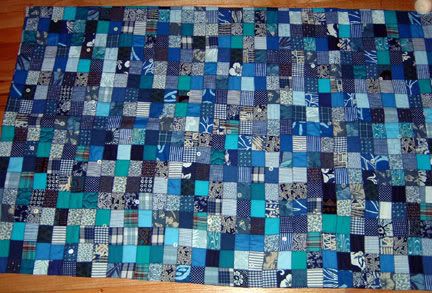
Cotton side. This quilt is tied using buttons on the cotton side.
-----------------------------------------------

This is a twin-bed sized quilt, the light fabrics are all rag wool felts. Pieced cotton back. ¶ 11:06 PM
Anyway, the wool felt I use is made by washing wool/wool blend fabrics, knit and woven, in hot, soapy water in a washing machine until it felts. I remove any labels, buttons, zippers, etc, ( I felt mostly clothing, but yardage works as well), then I put the items into pillowcases and tie the ends closed. The pillowcases helps contain some of the lint that making felt generates, and it does generate quite a lot of lint. I also recommend a lint screen on the drain hose of your washing machine to prevent plumbing problems if you are going to do much of this. I wash several items at a time, lights and darks separated. I wash whites totally separately and have separate pillow cases just for whites, which keeps them from looking dingy when they pick up other colors of wool lint and it felts into the surface. I dry the pieces between washes in a hot dryer, again I want to caution anyone who tries this to be aware of the lint situation, keep your dryer cleaned out and an eye on your vent hose if you do much of this. Different wools felt at different rates, some will felt up nicely in a single 10-15 minute cycle, others can take 8-10 cycles. And some have defied my efforts and refused to felt at all.
Most of the felt in the blankets posted here today and yesterday came from sweaters. My favorites are Shetland and Icelandic wools, they quickly morph into dense, opulent, rather coarse felts. I also like Merino and mohair/angora blends, they almost instantly turn into incredibly soft, slightly fuzzy felts. Rag wool, which is only 85% wool, becomes a thick, beautiful, very coarse felt, but it takes patience and many cycles through the machine.
For me, the effort required to make the felt has been more than worth it. I like the idea of recycling, like the idea that I can produce beautiful fabric from discards at a very reasonable cost, but mostly I just like the felt!
Hope I provided the details you were looking for, Debra.
Here are pictures of a couple more "fulled wool quilts." I made both of these several years ago.
Wool side
Cotton side. This quilt is tied using buttons on the cotton side.
-----------------------------------------------
This is a twin-bed sized quilt, the light fabrics are all rag wool felts. Pieced cotton back. ¶ 11:06 PM
January 01, 2006
Fulled Wool Quilts
Finished both of these pieces last week, they were made to be lap quilts and are marvelous to snuggle under. I've made a number of similar quilts in the last few years, some are decorating walls while others are on beds keeping family and friends warm. The tops are made of pieces of fulled wool joined by zig-zagging over the butted-together edges.

approx. 48 x 50" The center field of squares are quilted diagonally, the quilting in the border areas runs parallel to the edges

pieced back.
----------------------------------------------------------------------------------------------------

approx. 40 x 48" Quilted with burgundy-pink-black variegated thread. My cat Felix insisted on laying on the quilt during this photography session as you can see!

Whole-cloth backing using a piece of fabric that came bundled in with some other things in a yard sale purchase last spring. Turned out to be exactly the size I was looking for when I started thinking about backing this quilt.
I cannot say enough good things about working with fulled wool. I love the way it feels, it gets very, very soft as it is fulled. I love the amount of stretch and ease that are available with this fabric, and it responds wonderfully to steaming, allowing the fabric to be contorted and manipulated in amazing ways. Most of it retains interesting textures from the patterns originally knit into the fabric, and usually both sides of the resulting fabric are equally usable. The fulled fabric doesn't fray or ravel, and is dense enough to hold the zig zag stitching without tearing out while I am working on it. I always put a backing on these wool tops because the weight of them would pull the stitching out eventually. I usually use a piece of a cotton sheet between the top and the backing. The resulting quilts are very warm and quite heavy, and they have an unmistakably luxurious feel to them.
¶ 4:16 PM
approx. 48 x 50" The center field of squares are quilted diagonally, the quilting in the border areas runs parallel to the edges
pieced back.
----------------------------------------------------------------------------------------------------
approx. 40 x 48" Quilted with burgundy-pink-black variegated thread. My cat Felix insisted on laying on the quilt during this photography session as you can see!
Whole-cloth backing using a piece of fabric that came bundled in with some other things in a yard sale purchase last spring. Turned out to be exactly the size I was looking for when I started thinking about backing this quilt.
I cannot say enough good things about working with fulled wool. I love the way it feels, it gets very, very soft as it is fulled. I love the amount of stretch and ease that are available with this fabric, and it responds wonderfully to steaming, allowing the fabric to be contorted and manipulated in amazing ways. Most of it retains interesting textures from the patterns originally knit into the fabric, and usually both sides of the resulting fabric are equally usable. The fulled fabric doesn't fray or ravel, and is dense enough to hold the zig zag stitching without tearing out while I am working on it. I always put a backing on these wool tops because the weight of them would pull the stitching out eventually. I usually use a piece of a cotton sheet between the top and the backing. The resulting quilts are very warm and quite heavy, and they have an unmistakably luxurious feel to them.
¶ 4:16 PM